28 Mar 2026
Migrating from Ingress NGINX to the Gateway API with kgateway
Kubernetes announced that Ingress NGINX would no longer be supported, and we had to make a decision. Should we move to a different Ingress controller? Or should we skip that and do a big-bang cutover to the Gateway API, with a Gateway controller installed?
We had a lot riding on the answer. Over time we had built up many small configurations in Ingress NGINX that would need a new home: buffer policies, IP allowlists, rate limits, security headers and request headers. In the end, the deprecation turned out to be the best thing that could have happened to us, for both maintainability and performance.
Ingress or Gateway API?
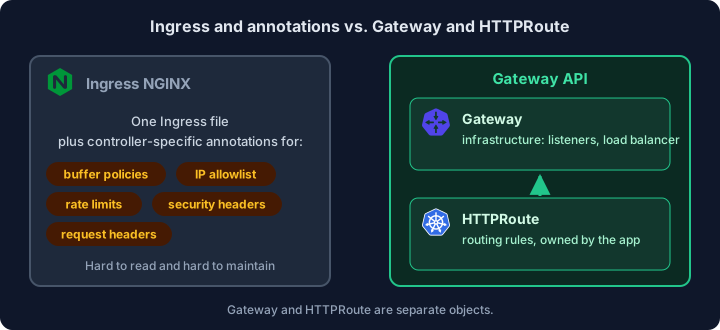
We started with an investigation: Gateway API against Ingress. The difference was clear. With Ingress, we had to
rely on ugly NGINX annotations in our Ingress files. The Gateway API is much better. It separates the
infrastructure (Gateway objects) from the routing rules (HTTPRoute objects), so each can be owned by the people
who care about it.
Once we agreed that the Gateway API was the way to go, we moved on to choosing a controller.
Choosing a controller
We did a vendor selection, and the final three were kgateway, Istio and Traefik. We had looked at the gateway-api-bench benchmark, but we decided to test them ourselves.
We set up a proof of concept and used Grafana k6 to load test the three controllers against each other. We had a clear winner.
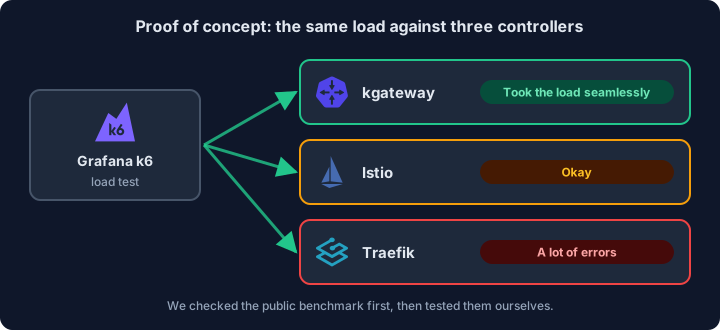
We chose kgateway, which is built on Envoy.
Migrating the Ingress resources
Next we had to move every Ingress over to the Gateway API. Kubernetes has a tool for this, ingress2gateway, and it made the process much easier. Two things still needed our own work:
- An auth adapter. We relied on an NGINX proxy that redirected traffic to another endpoint before it went to the internal service. To keep this working, we had to build an auth adapter with NGINX.
- Rate limits. Rate limiting is configured differently in kgateway than in NGINX, and there were a lot of differences between the two.
A better setup for developers
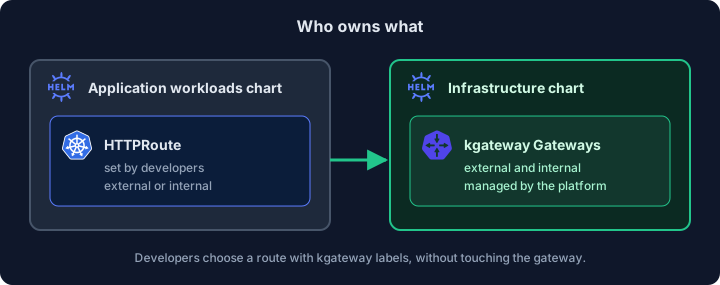
We added the HTTPRoute objects to our application workloads Helm chart, and set up the kgateway Gateway
objects in a separate infrastructure Helm chart. The result is that developers can now configure external and
internal routes very easily, using kgateway labels in an abstract way.
How we rolled it out
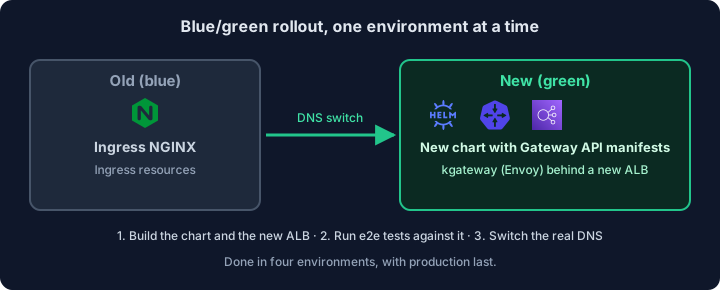
We used a blue/green approach. We created a separate chart with the Gateway API manifests and a new ALB pointing to it. We ran end-to-end tests against the new ALB, and then switched the real DNS over to it.
We did this in four environments, with production last.
The outcome
The difference in performance was massive. Ingress NGINX being deprecated was something we feared, because of all the small configurations we would have to move. But once we had finished, it was the best thing that could have happened to us, from both a maintainability and a performance point of view.